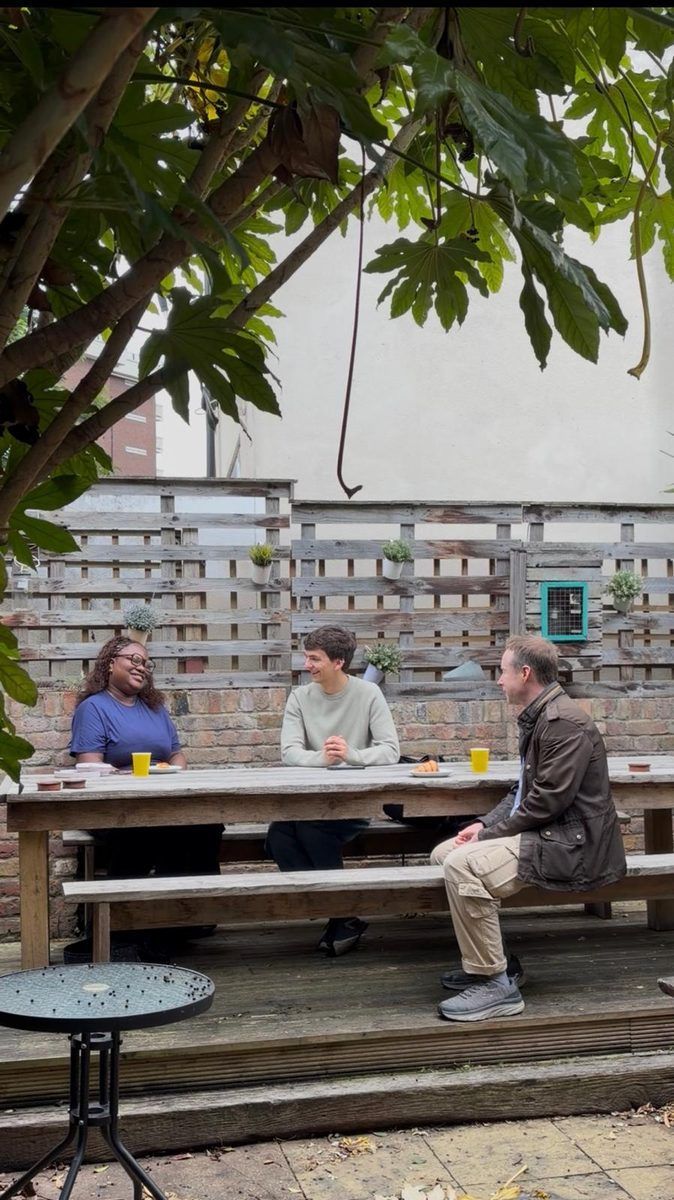
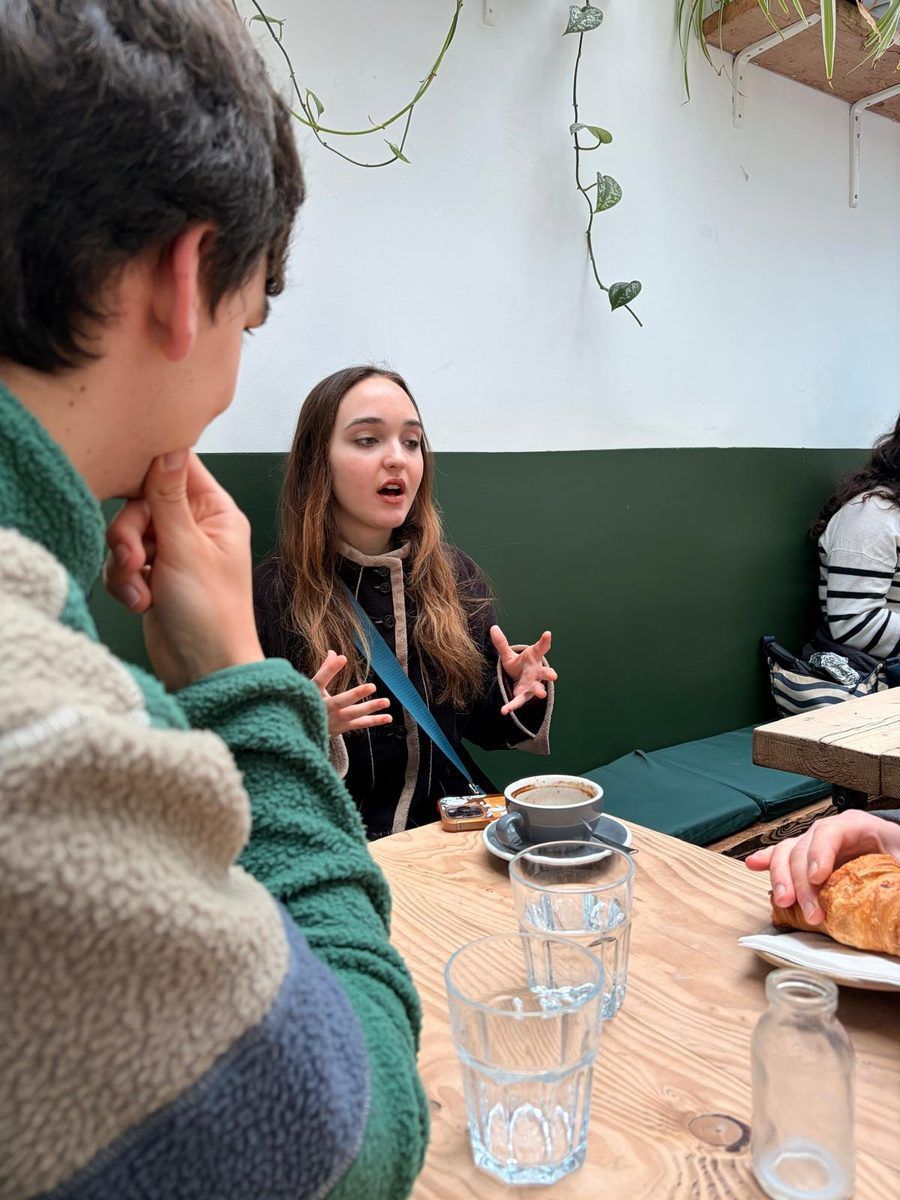
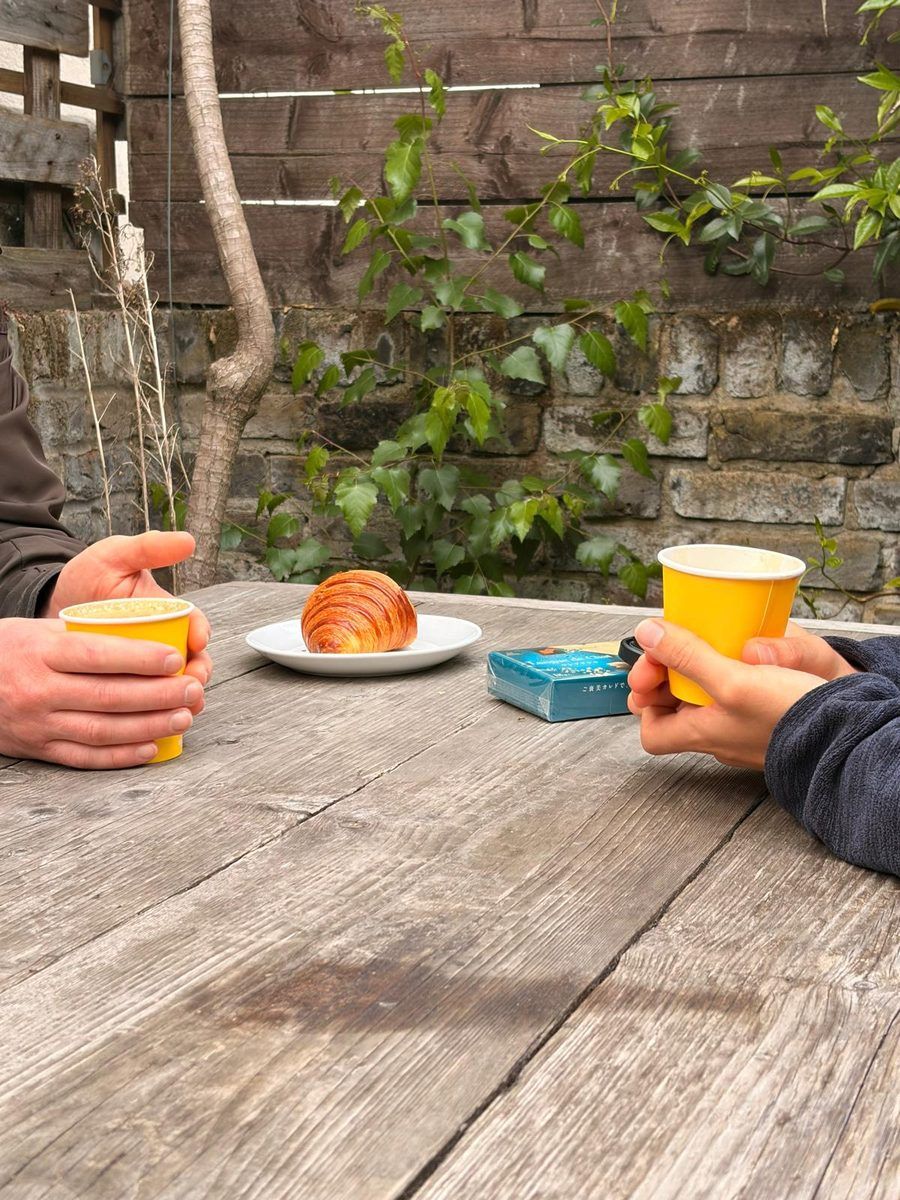
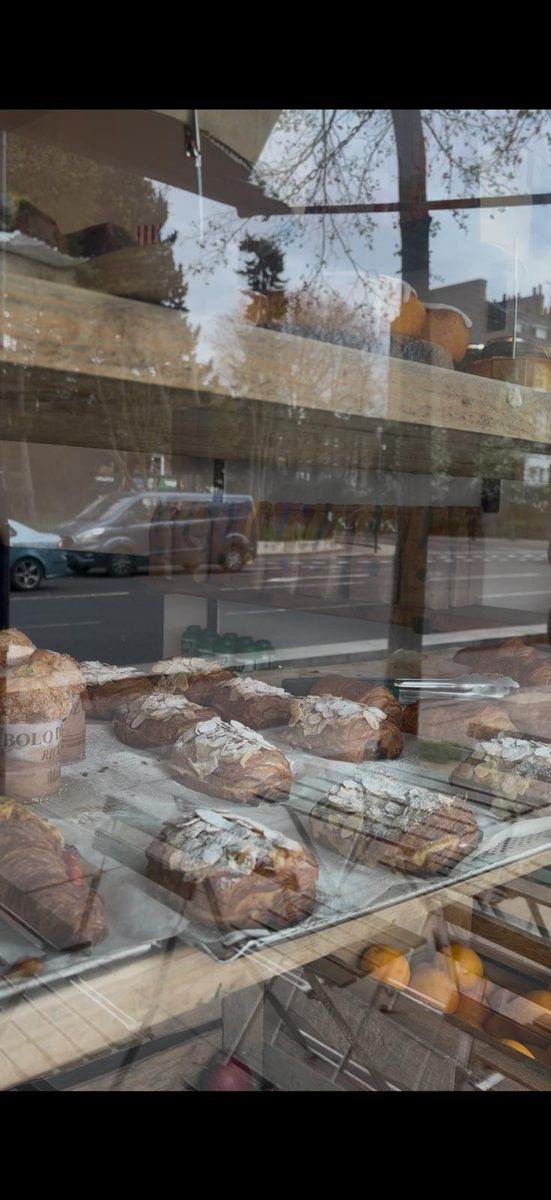
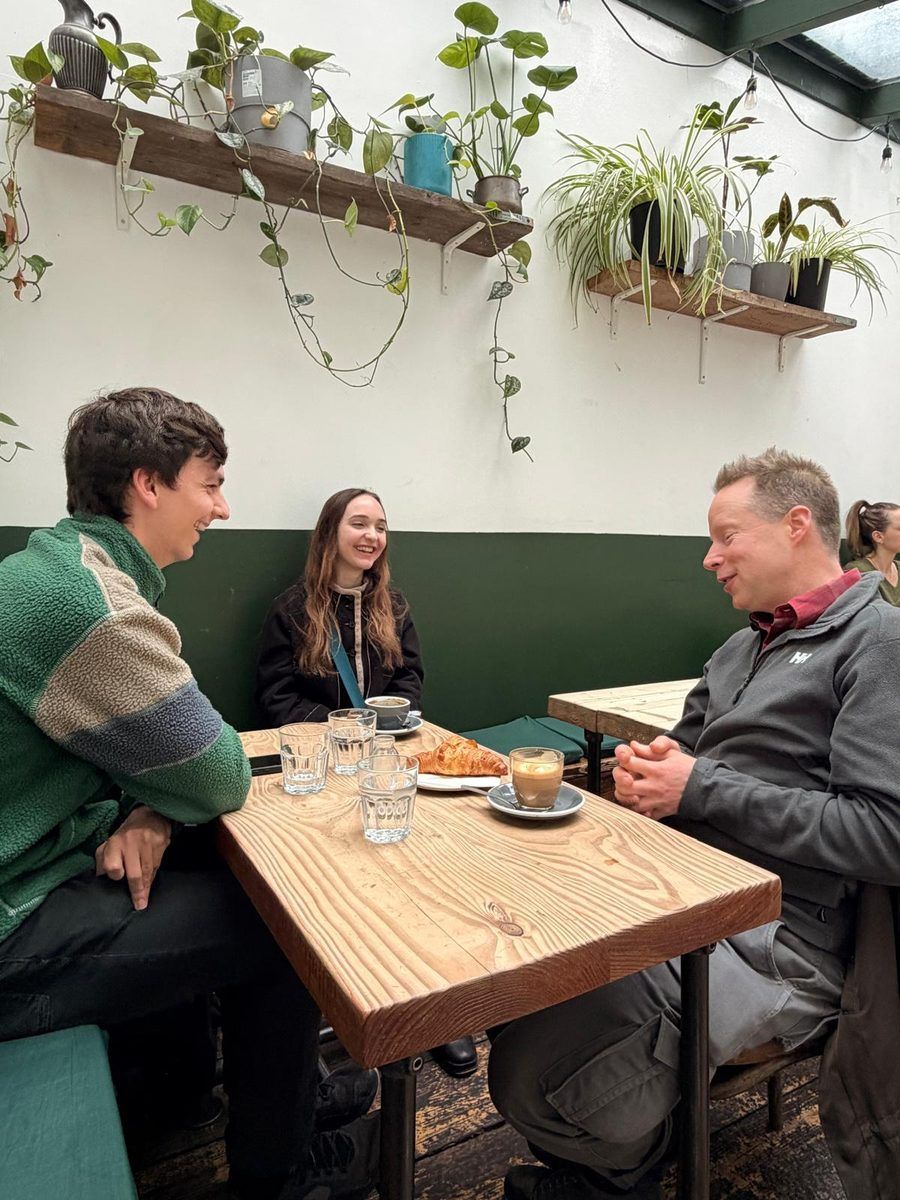
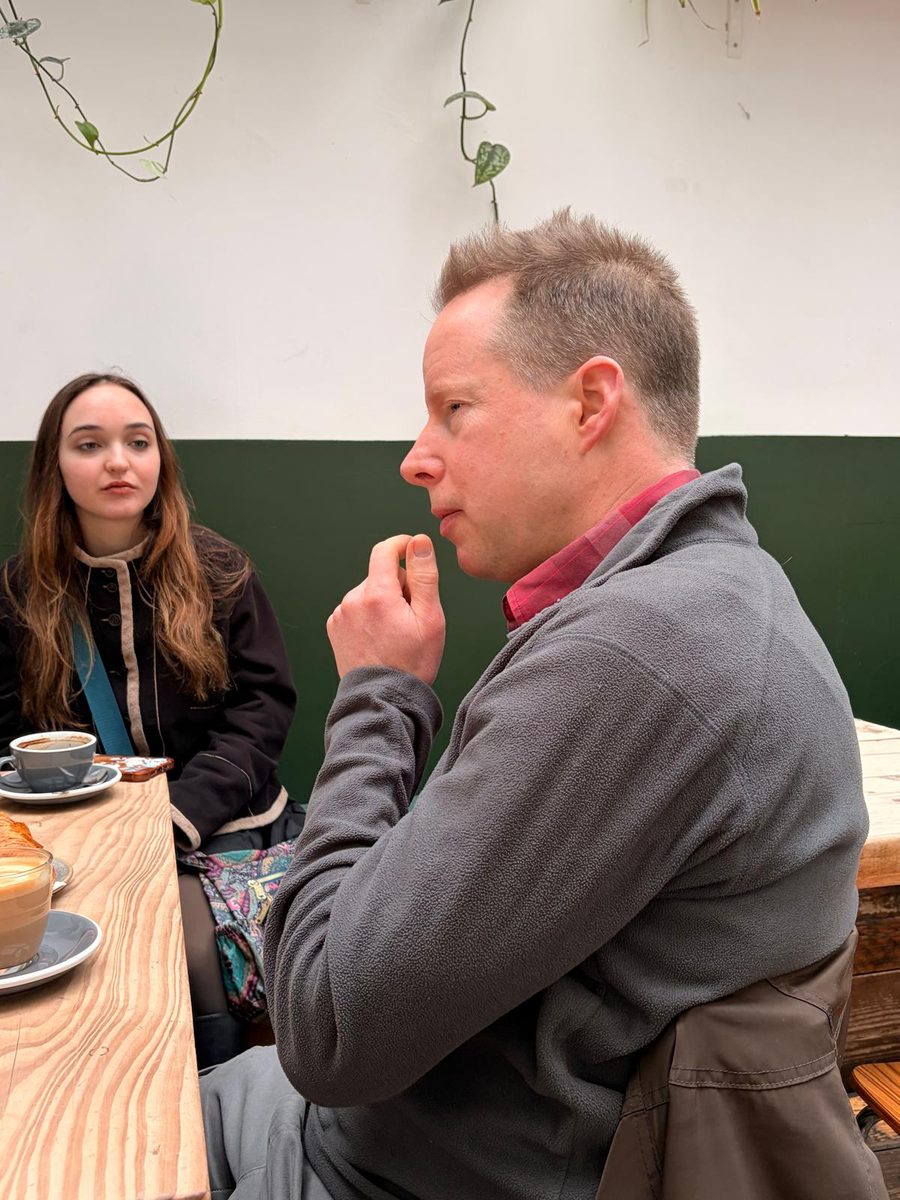
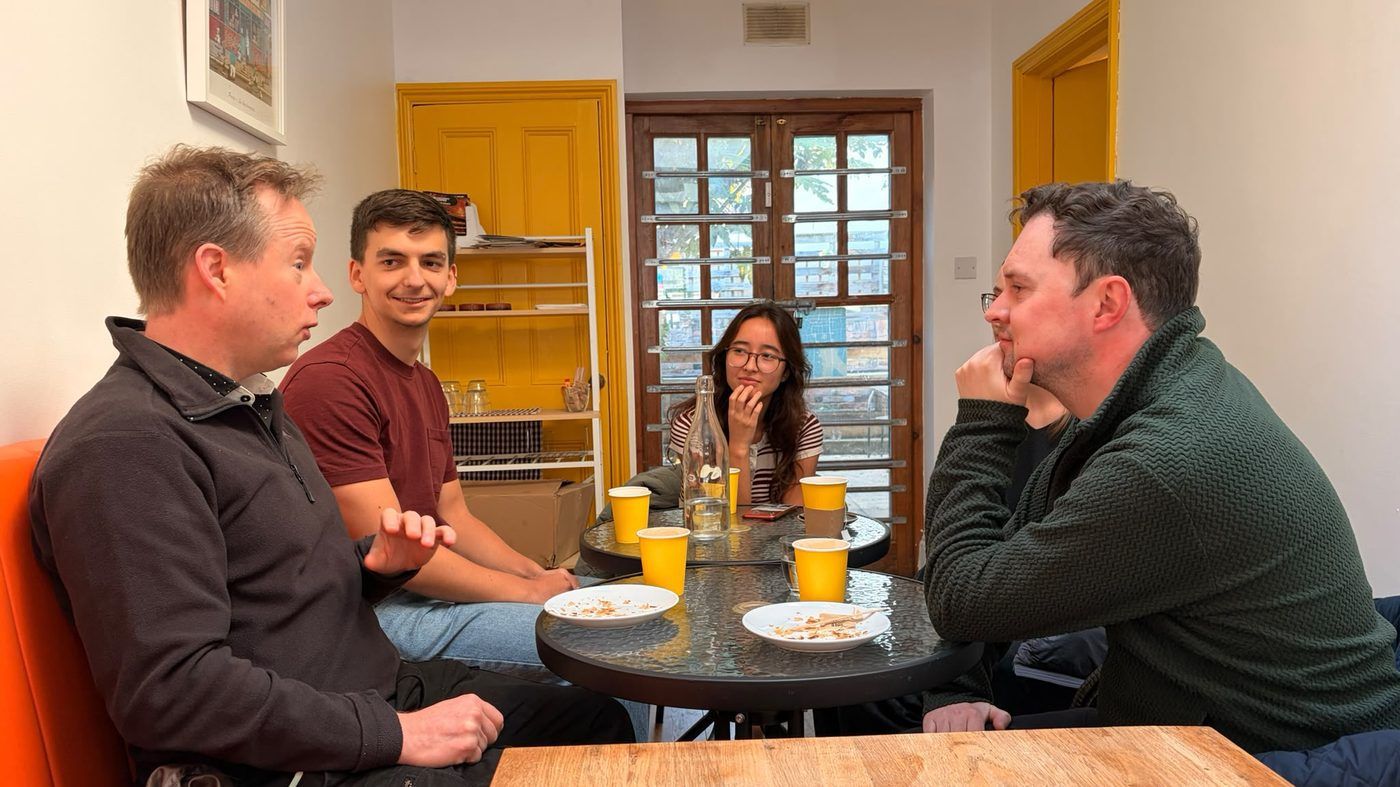
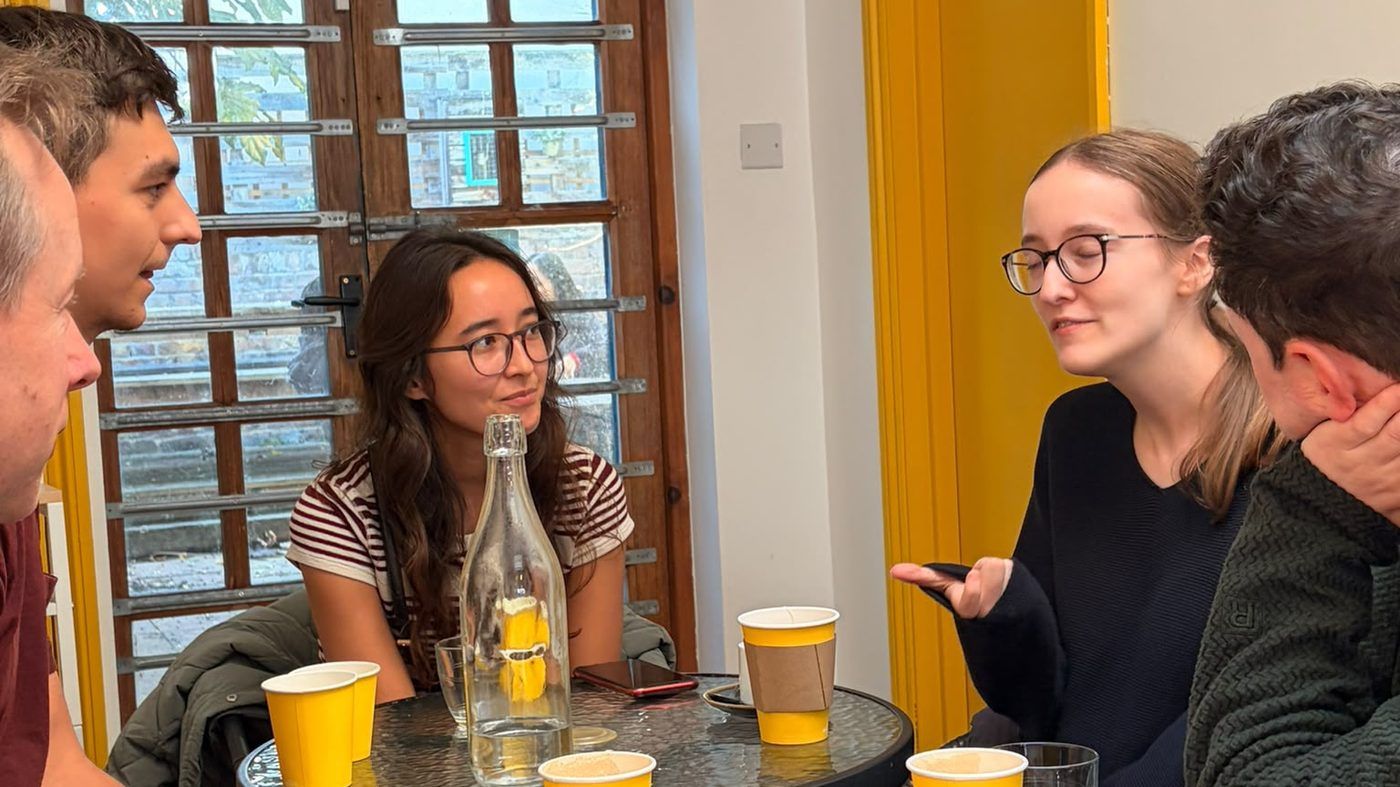
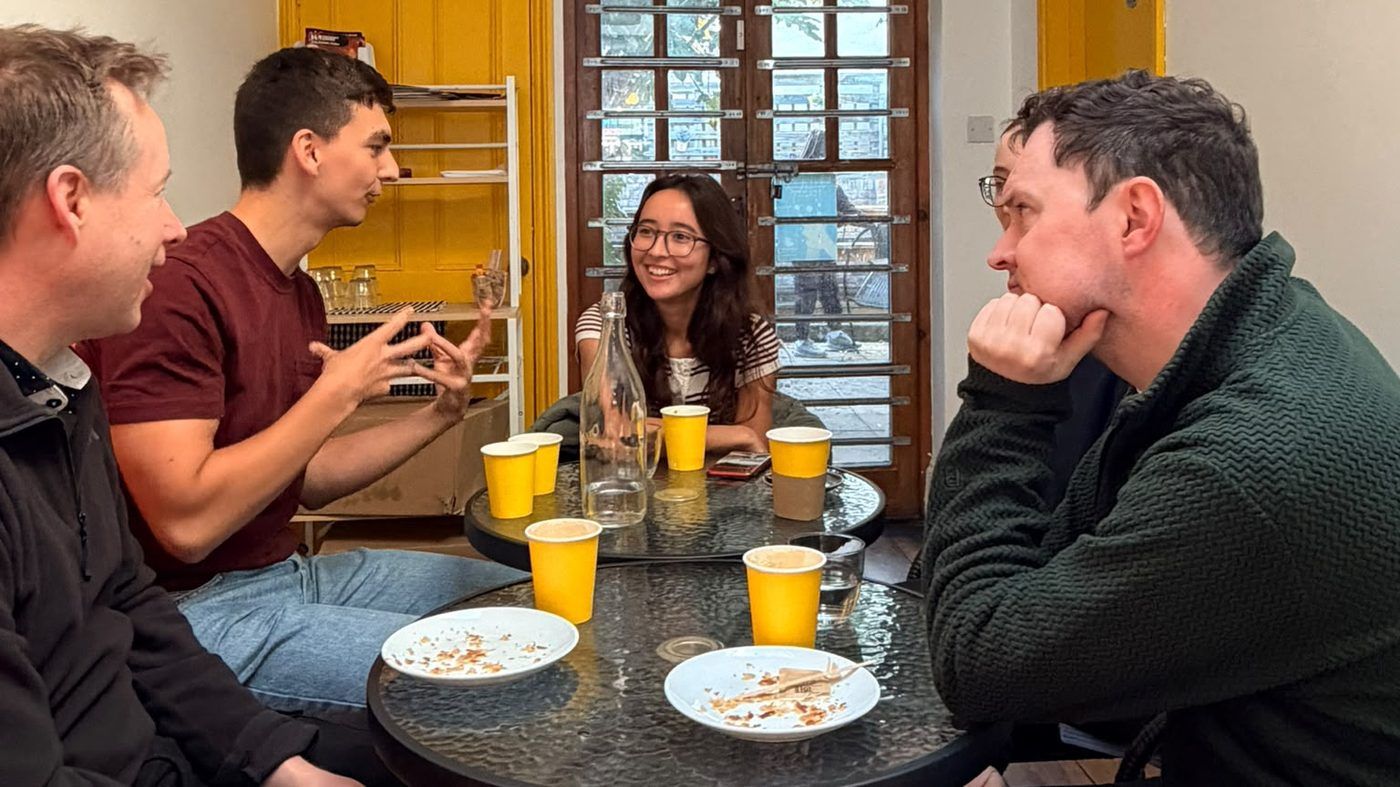
Our conversation classes are held in actual London cafés, where real conversations happen. No classrooms, no whiteboards.
👥
Small groups, more speaking
Every learner gets meaningful speaking time in our small-group classes. No sitting quietly while others talk: you practise from the moment you sit down.
🎙️
Fluency, not grammar
We focus on small talk, travel situations and spontaneous conversation, the things that matter when you're travelling or chatting with colleagues and friends.
🌍
Native teachers
Every session is led by a native speaker based in London, who knows how to unlock confident, natural expression, not just technically correct sentences.
🇮🇹 Italian sessions are launching soon in London. Join the waitlist and we'll let you know when the first session goes live.
Private tutoring
1:1 lessons with native teachers
Group sessions build confidence and spontaneity. Private lessons target your specific gaps, pace, and goals. Most learners who progress fastest use both. Our native teachers offer 1:1 sessions in French, Spanish and Italian. Get in touch to arrange a format and time that suit you.
🇫🇷
French tutoring
Tailored 1:1 French sessions with a native teacher. Exam prep, travel French, business French, or simply filling the gaps.
Private Spanish sessions with a native teacher. Whether you're starting from scratch or want to stop freezing mid-sentence, sessions are built around your actual goals.
Learn Italian 1:1 with a native speaker. From absolute beginner to conversationally confident, with private sessions that move at your pace and on your schedule.
Pick a session below and pay securely online. Groups are small (max 6) so everyone gets time to speak. No account needed.
1Choose a date
2Pay securely with Stripe
3Get your email confirmation
🔒Payments are processed securely by Stripe. Your card details never touch this site. You'll get an email receipt straight after paying, and we'll confirm the exact venue before your session.
"In only one session, I felt like I had caught up on months of French that I had left behind! Jaime created a very relaxed and friendly environment where we could talk about a variety of topics."
Alexia S. · Google review ★★★★★
Common questions
Everything you need to know
What is Babel Social?
Babel Social is an experiential language learning community in London. We believe the best way to learn a language is to use it in real situations, with real people, in real places. No classrooms. No pressure. Just connection, culture, and confidence.
Do I need to be good at the language?
No. If you can introduce yourself and understand simple phrases, you'll be fine. Sessions are relaxed and supportive, our teachers are here to help you, not judge you.
What will we learn in a session?
You'll practise key phrases for real-life situations: cafés, restaurants, travel and small talk, including ordering, asking questions, and speaking confidently in everyday conversations.
Is food included?
Food and drinks are not included, but you're free to order whatever you like. Many guests choose something simple like a coffee or pastry. It adds to the atmosphere!
Where do sessions take place in London?
French sessions are at L'Authentique Boulangerie in Finsbury Park (N4) and Spanish sessions are at La Farola Café & Bistro on Upper Street, Islington (N1). We email the exact venue before each session in case it changes. No classrooms, just real cafés and real conversation.
When are sessions held?
French café socials run every Sunday 10:00–11:00am at L'Authentique Boulangerie, Finsbury Park N4. Spanish café socials run every Saturday 10:00–11:00am at La Farola Café & Bistro, Upper Street N1. We email the exact venue before each session in case it changes.
What level do I need?
Most sessions are suited to A2–B2 learners (elementary to upper intermediate). If you're unsure of your level, get in touch and we'll advise the best fit for you.
How much does a session cost?
Group café social sessions are £25 per session, no subscription, no commitment. Book individual sessions as and when suits you.
Is this different from a standard language course?
Yes. Traditional language courses focus on grammar and written exercises. Babel Social is purely conversational. You speak from the moment you sit down, in a real café, with a native teacher and a small group of motivated learners.
Do you offer 1:1 tutoring?
Yes, private tutoring is available in addition to the group sessions. Get in touch via the contact form and we'll arrange a tailored plan.
Do you offer Spanish and Italian classes?
Yes, Spanish café socials run every Saturday at 10am at La Farola Café & Bistro, Upper Street, Islington N1. Italian sessions are launching soon. Get in touch to join the Italian waitlist.
Most French learners in London know far more than they think. They've taken classes, used apps, watched films with subtitles. But the moment someone speaks French to them in real life, everything disappears. This is called the confidence gap, and it's the most common obstacle between an intermediate learner and genuine fluency.
The good news? It's fixable. Here are five things that actually work.
1. Stop waiting until you're "ready"
There is no ready. Fluency doesn't come before speaking. It comes from speaking. Every French learner who now speaks confidently got there by starting before they felt prepared. The discomfort of imperfection is part of the process, not a sign you need more study.
2. Speak French in low-stakes situations first
London has a surprisingly large French-speaking community. Start small: order your coffee in French at a French bakery in South Kensington, say bonjour to a French colleague, join a small group conversation session where everyone is in the same boat. Small wins build the confidence muscle.
3. Focus on phrases, not grammar
Native speakers don't think about grammar when they talk. They've internalised chunks of language. Learn complete phrases like c'est pas grave, vous pouvez répéter ?, or je cherche quelque chose comme ça. These building blocks unlock real conversation faster than any grammar rule.
4. Embrace mistakes as proof you're trying
French people, especially in London, genuinely appreciate when someone makes the effort to speak their language. A mistake followed by a smile is more charming than perfect silence. Shift your mindset: every error is data, not embarrassment.
5. Find your people
The fastest way to improve is regular, relaxed practice with others who are on the same journey. A weekly French conversation session in a London café, with a native teacher and a small supportive group, gives you the accountability, the environment, and the vocabulary you'd never get from an app alone.
Why café conversations beat classroom French every time
Babel Social · June 2026 · 3 min read
You spent two years in French classes. You know the subjunctive. You can write a formal letter to a French mayor. And yet, the last time you tried to speak French in a real situation, your mind went blank. Sound familiar?
This isn't a failure of memory or intelligence. It's a failure of context.
Why classrooms don't prepare you for real conversation
Classrooms teach you French as an academic subject. The vocabulary is abstract, the situations are hypothetical, and the pressure, even in the most relaxed class, is about getting things right. Your brain files this information away as "school knowledge," separate from the language you use to live your life.
Real conversation doesn't work like that. It's fast, unpredictable, full of slang, interruptions, and cultural references no textbook covers. The gap between classroom French and real French is enormous, and the only way to close it is by practising in real situations.
What happens when you learn in a café
When you practise French in an actual café, something shifts. The ambient noise, the smell of coffee, the act of ordering, all of it creates the kind of context your brain needs to store language as lived experience rather than studied material. You're not performing French. You're using it.
Small groups make this even more powerful. With 4–6 people, everyone speaks far more than they would in a class of twenty. The teacher guides rather than lectures. The conversation flows naturally. And crucially, everyone is on the same side. There's no judgment, only encouragement.
What changes with practice
With regular practice, most learners find they gradually stop translating in their heads. Words start coming more easily and the freeze response fades. That's not magic. It's what happens when you practise speaking in the environment where speaking actually happens.
The best neighbourhoods in London to practise French
Babel Social · June 2026 · 3 min read
London is one of the most linguistically diverse cities in the world, and French is one of its most spoken languages. London is home to a large French-speaking community, so you can hear French in more places than you might expect. Here's where to look.
South Kensington: the French quarter
This is the heartland of French London. The Lycée Français Charles de Gaulle, the Institut Français, and a cluster of French bakeries, pharmacies and restaurants make this the closest thing to a French neighbourhood in the city. Walk down Cromwell Road on a Saturday morning and you'll hear more French than English.
Notting Hill and West London
West London has long had a strong French presence. The farmers markets, bakeries and independent cafés are all good places to catch a French conversation in the wild.
Angel & Islington
North London has French bakeries and cafés in Islington, Highbury and Finsbury Park. It's also where our Babel Social sessions take place, in the kind of neighbourhood café that feels, on a good Sunday morning, not entirely unlike Paris.
Anywhere with a Babel Social session
The most reliable place to practise French in London isn't a neighbourhood. It's a session. Every Sunday morning, Babel Social brings together a small group of motivated learners and a native French teacher in a local café. No commute to South Ken required.
1:1 language sessions in London: what to expect and who they're for
Babel Social · June 2026 · 4 min read
When people think "private tutoring," they often picture something formal: a tutor across the table, a textbook open, homework assigned for next week. In London, 1:1 language sessions can absolutely look like that, but they don't have to, and for most learners, they shouldn't.
Here's what 1:1 sessions actually involve, who benefits most, and how to know if it's the right format for you.
What a 1:1 session actually looks like
A good private session is built entirely around you: your goals, your pace, your gaps. There's no curriculum to keep up with and no group to wait for. If you need ten minutes on the subjunctive because it's tripping you up, you get ten minutes on the subjunctive. If you want to spend a whole session rehearsing for a work trip to Madrid, that's the whole session.
This flexibility is the entire point. A tutor working one-to-one can hear exactly where your pronunciation slips, which structures you avoid out of uncertainty, and which vocabulary you're missing, then correct it in real time, every time. In a group, that level of individual feedback simply isn't possible.
Who gets the most out of 1:1 sessions
Three types of learners see outsized results from private sessions. Complete beginners benefit from a tutor who can slow down, repeat, and build foundational confidence without the self-consciousness of speaking in front of strangers. Learners with a specific goal, an upcoming exam, a job interview, a house move abroad, benefit from content that's laser-focused on exactly what they need. And advanced learners chasing the final 10% of fluency benefit from a tutor who can catch the subtle mistakes that no group setting would ever flag.
The honest limitation
What 1:1 sessions don't replicate is the unpredictability of real conversation. A tutor, however good, tends to adapt to you, slowing down when you struggle, rephrasing when you're lost. Real native speakers in the wild don't do that. That's a genuine gap, and it's worth knowing about before you commit to private sessions alone.
Curious whether 1:1 or group sessions fit you better?
Private vs group language tutoring in London: which is right for you?
Babel Social · June 2026 · 5 min read
This question gets asked constantly, and it's usually framed as a choice: private tutoring or group classes, pick one. In our experience, that framing is the problem. The learners who progress fastest in London aren't the ones who pick a side. They're the ones who use both, deliberately, for what each is actually good at.
What private tutoring does well
One-to-one sessions are unmatched for precision. A private tutor can target your specific weak points, correct your mistakes the moment they happen, and build a learning plan around your exact goals, whether that's an exam, a work trip, or closing a particular grammar gap that's been bothering you for months. If you want efficient, structured progress on the technical side of a language, nothing beats focused 1:1 time.
What group sessions do well
What private tutoring can't easily replicate is unpredictability. In a group, especially a small, conversation-led one like a café social, you're reacting to other people in real time. You don't know what the person next to you is about to say. You have to listen, process, and respond on the spot, exactly like you would with a native speaker on the street. Group settings also build something private lessons rarely touch directly: the confidence to speak in front of others without freezing.
Why the combination wins
Here's a pattern that works well. A learner takes a private session to work through a specific weakness, say, past tense conjugation, with focused correction and practice. Then, within the same week, they bring that same structure into a group café social, where they're forced to use it spontaneously, under the light social pressure of real conversation, without a tutor stepping in to rescue them. The private session builds the tool. The group session proves you can actually use it.
Learners who rely on private tutoring alone often report a strange gap: they can produce near-perfect French in a lesson, but freeze the moment a real conversation moves faster than expected. Learners who rely on groups alone sometimes plateau because nobody is correcting their recurring mistakes. Combining both closes both gaps at once.
A practical way to combine them
You don't need to do this every week to see the benefit. A simple routine is to book a 1:1 session every few weeks to target something specific, while attending a weekly café social as your regular practice ground. The structure handles depth; the social handles fluency under pressure. Together, they cover what either one misses alone.
Want to combine 1:1 tutoring with our group sessions?
Learning Spanish in London: a practical guide to getting started
Babel Social · June 2026 · 4 min read
Spanish is the world's second most spoken native language, and London has a large Spanish-speaking community. Despite that, most people learning Spanish in the city are doing it through an app, alone, with nobody to actually speak to. Here's how to change that.
Where Spanish lives in London
Elephant & Castle and Brixton have long-standing Latin American communities, and you'll hear Spanish in the cafés, shops and markets across both areas. If you want immersion without leaving London, these are good neighbourhoods to spend time in.
Why most self-taught Spanish stalls out
Spanish has a reputation for being one of the "easier" languages for English speakers, the grammar is relatively regular, the spelling is phonetic, and there's no shortage of learning apps. That ease is part of the problem: learners often get comfortable with vocabulary and basic structure through an app, then hit a wall the first time they try to have an actual conversation. Apps are excellent at building recognition. They're poor at building production, the ability to generate spontaneous spoken sentences under time pressure.
What actually closes that gap
The fix isn't more app time. It's structured speaking practice with real feedback, ideally with both a native speaker and other learners in the room. A small group setting, like a café conversation social, forces you to produce language on the spot, in front of people, the way real conversation actually works. Pairing that with the cultural context of food, expressions, and humour makes the vocabulary stick in a way flashcards rarely do.
Practise every Saturday in Islington
Our Spanish café social runs every Saturday at 10am at La Farola Café & Bistro on Upper Street, led by a native Spanish-speaking teacher, in the same small-group, conversation-first format as our French sessions. If you've been stuck at the "I understand more than I can say" stage, this is built for you.
Why Italian is one of the most rewarding languages to learn in London
Babel Social · June 2026 · 4 min read
Italian has a strange dual reputation. On one hand, it's considered one of the "easy" languages for English speakers to pick up, melodic, phonetic, full of words that already feel familiar. On the other hand, anyone who's tried to keep up with a table of Italians mid-conversation knows it can feel impossibly fast and idiomatic. Both reputations are true, and understanding why is the key to actually learning it.
Why Italian feels approachable at first
Italian pronunciation is refreshingly consistent. What you see is largely what you say, unlike English or French. Many words share obvious roots with English through Latin, which means vocabulary often feels like a head start rather than a blank page. This is why so many beginners feel real momentum in their first few weeks.
Why that momentum often stalls
The gap shows up the same way it does in every language: real spoken Italian moves fast, drops words, and leans heavily on gesture, tone, and regional expressions that no course covers. Italians also tend to speak in a way that's wonderfully expressive but genuinely difficult to follow if your only practice has been structured exercises. The learners who plateau are almost always the ones who've only ever practised Italian in a controlled, predictable setting.
London's Italian community
London has a substantial and growing Italian population, with strong communities around Clerkenwell, historically known as London's "Little Italy", as well as in areas like Soho, where Italian delis, cafés and restaurants have operated for generations. It's entirely possible to find genuine Italian conversation in this city without booking a flight.
What actually builds fluency
The same principle applies here as with any language: passive study builds recognition, but only active conversation builds the ability to speak. Regular, low-pressure conversation practice, ideally with a native speaker guiding the group, is what turns "I can read a menu" into "I can hold a conversation." That's the gap our Italian café socials are designed to close.
Be the first to know when Italian sessions launch.
The best French cafés in North London for language learners
Babel Social · October 2026 · 3 min read
You don't need to cross the Channel to practise your French in a setting that feels French. North London has a growing number of bakeries and cafés run by French owners and staffed by French speakers, which makes them ideal places to practise ordering, chatting and listening.
Authentique Boulangerie in Finsbury Park, Tufnell Park and Islington
Authentique is an artisanal French bakery group with branches in Finsbury Park (Blackstock Road), Tufnell Park (Fortess Road) and a newer one on Upper Street in Islington. Pastries, bread, coffee and a deli counter, with indoor seating and, at Finsbury Park, a garden. It's also where our Sunday French café socials take place, so you can come and practise in a real French bakery with a native teacher.
Why a French café beats a classroom for practice
In a café, the language has a purpose. You order a coffee, ask what's in the sandwich, and react to what the person next to you says. That is exactly the situation you will face in France, and it trains the skills a textbook cannot: listening at normal speed, answering without preparation, and being comfortable making mistakes.
How to practise on your own
Go at a quiet time, order in French, and ask one extra question you would normally skip, such as "Qu'est-ce que vous me conseillez ?" (what do you recommend?). Most staff are happy to help, and a small effort is almost always appreciated.
Or practise with a group
If you'd rather not do it alone, join our Sunday session. Small group, native teacher, a real café, and everyone there to practise too.
How to make the most of a language café social: 5 tips
Babel Social · October 2026 · 4 min read
Turning up to a conversation session is the hardest part. Once you're there, a few habits make the hour far more useful.
1. Say something in the first five minutes
The longer you wait to speak, the harder it gets. Introduce yourself, say where you're from, or just order your coffee in the language. Once you've said one sentence aloud, the rest comes more easily.
2. Aim for communication, not perfection
If you can get your meaning across, you've succeeded. Correct grammar will come with practice; confidence comes first, and it only grows by speaking.
3. Ask questions back
Questions keep a conversation going and give you time to listen. They also let you practise the question forms that many learners avoid.
4. Note down new words afterwards, not during
Writing mid-conversation breaks the flow. Instead, jot down three or four new words or phrases straight after the session, while you still remember them, and use them in the next one.
5. Come back regularly
One session helps, but weekly practice is what makes the difference. Short, regular speaking beats an occasional long session, and you start to recognise the same faces and build real conversations.
5 reasons to start speaking Spanish in London this year
Babel Social · October 2026 · 4 min read
Spanish is spoken natively by nearly 500 million people and is an official language in around 20 countries. London is also home to a large Spanish-speaking community. Here are five reasons to start.
1. It opens up a huge part of the world
From Spain to Mexico, Colombia, Argentina and beyond, Spanish gives you a way into very different cultures, cuisines and travel experiences, often with warmer, more relaxed conversations than you expect.
2. It's practical for work
Many London employers value a second language, and Spanish is often listed in roles involving clients, travel, hospitality and international teams.
3. The pronunciation is friendly
Spanish is largely pronounced the way it's written, so you can start speaking early without wrestling with spelling rules. That is a big confidence boost for beginners.
4. London makes practice easy
Spanish-speaking cafés, shops and communities exist across the city, and you can build practice into your week rather than only studying at home.
5. There's a weekly session on Saturdays
Our Spanish café social runs every Saturday at 10am at La Farola Café & Bistro on Upper Street, Islington. Small group, native teacher, and the focus is entirely on speaking.
Join this Saturday's Spanish session in Islington.